Improving Team Synchrony in Pediatric Intensive Care Teams

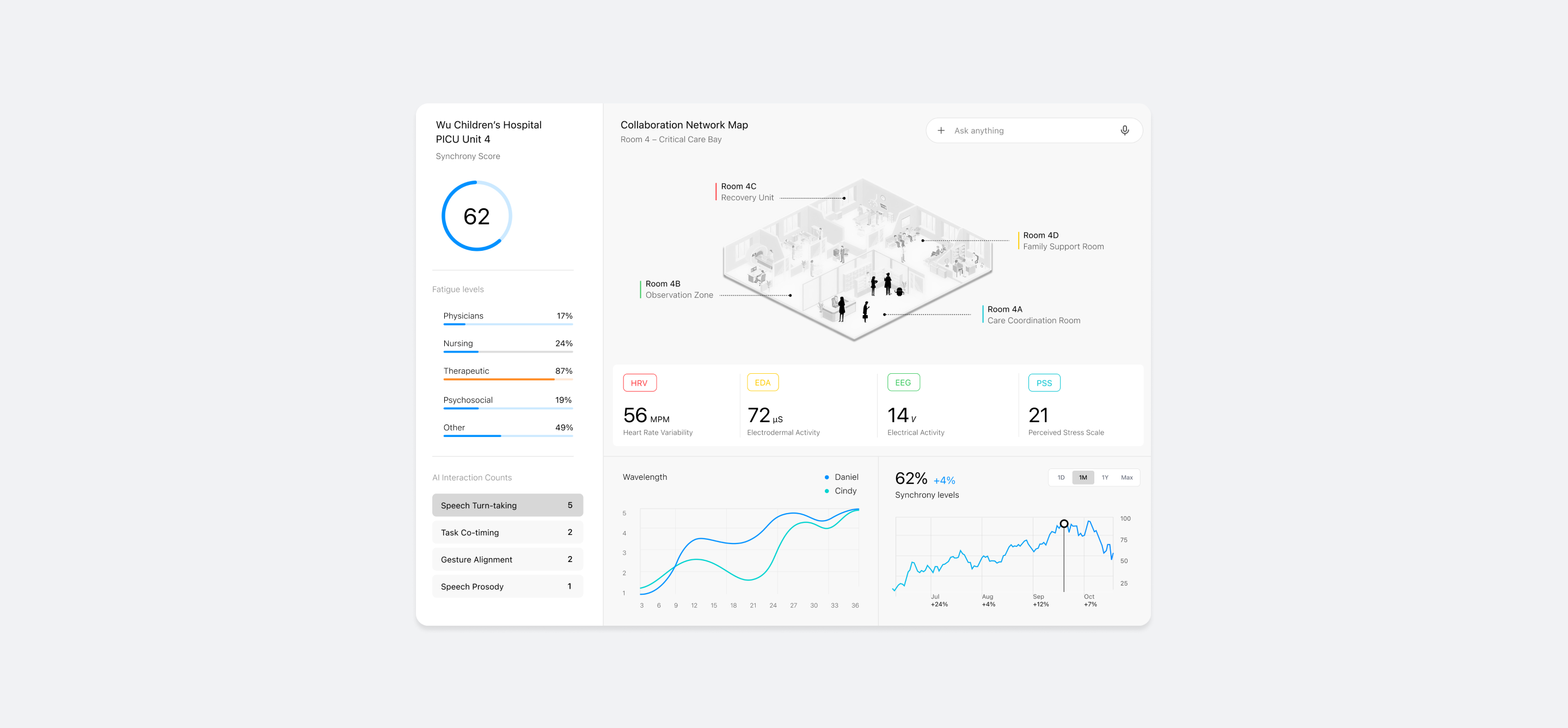
ICU Collaboration Dashboard Interface — 2 min read
see results

Role

Product Designer and Researcher

Product

Team Sync is an AI-driven system that measures team synchrony and promotes collaboration in the Pediatric ICU. It analyzes real-time physiological and behavioral signals, then provides empathic, well-timed prompts to help clinicians communicate more effectively.

Team

Jaxon Wu — Harvard PHD

Impact

In simulations, the GNN-RL coach outperformed random or static approaches, showing measurable improvements in synchrony. Teams maintained stronger connections. Burnout risks were reduced through fewer unnecessary alerts and higher-quality collaboration.

Healthcare is becoming increasingly stressful.

Professionals, specifically in the Pediatric Intensive Care Unit, face intense emotional strain, communication breakdowns, and high rates of burnout. A lack of synchrony among team members often results in heightened stress, inefficiency, and poor decision-making under pressure.

Team synchrony is proven to reduce stress and improve collaboration—two factors critical to high-precision tasks in Pediatric Intensive Care Teams.

Existing support systems fail because they overload clinicians with irrelevant alerts (alert fatigue) and do not adapt to the dynamic, high-stakes nature of ICU environments. The image below shows how synchrony can be measured using real-time physiological signals such as heart-rate variability and electrodermal activity. The result: "trained" reinforcement learning algorithms have much higher synchrony levels compared to random or static policies

Goal: Use Reinforcement Learning and Graph Neural Network to improve team synchrony.

RL-enhanced GNN: The AI learns how to build better team connection models — it experiments and improves the way the network understands relationships between people. GNN-enhanced RL: The AI uses those team relationship maps to make smarter coaching decisions, deciding when and how to prompt interactions.
The GNN helps the AI understand the team structure. The RL helps the AI learn how to coach the team better over time.

Outcome: Reduce human error. We designed an AI-driven ecosystem that monitors team synchrony, delivers prompts, and integrates robotic assistance to maximize collaboration and clinician well-being.

Providing ICU teams with a dashboard, interactive adaptive prompts, and robotic support can reduce human error and lower the risk of high-stakes emergencies. These interfaces reduce the burden of overwhelming alerts and notifications commonly experienced by doctors and nurses in hospital settings.